ASHTAVAKRA GEETA · ADVAITA DIALOGUE · CHAPTER 01
Ashtavakra Geeta: Chapter 1
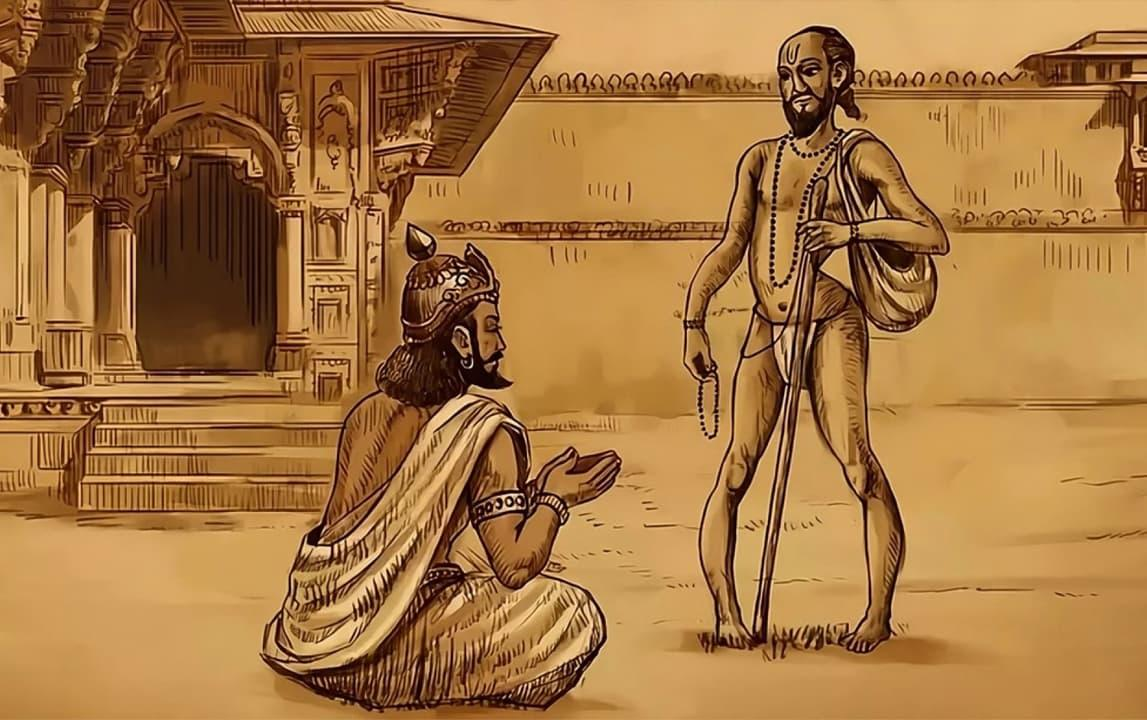
Janaka asks how knowledge, liberation, and dispassion are attained. Ashtavakra's answer does not simply say “you are the witness.” It dismantles the sentence “I am a bound person” by asking what the “I,” the bondage, and the knower of bondage actually are.
This reading treats Chapter 1 as a philosophical argument, not as a collection of inspirational Advaita claims. Each major verse is read through its Sanskrit wording, literal grammatical force, Advaitic assertion, possible misreading, and unresolved pressure.
The central question is immediate and difficult: if Atman is never bound, what can liberation mean without becoming empty rhetoric?
Primary questionWhat exactly does Ashtavakra mean when he tells Janaka that he is already free?
Primary dangerThe witness teaching can become a new concept, a detached ego, or an excuse to evade ordinary responsibility.
1. Janaka’s question: three problems, not three requests
कथं ज्ञानमवाप्नोति कथं मुक्तिर्भविष्यति।
वैराग्यं च कथं प्राप्तमेतद् ब्रूहि मम प्रभो॥How does one attain knowledge? How will liberation be? And how is dispassion obtained? Tell me this, my lord.
Literal grammar
- कथम्
- How, by what means
- ज्ञानम्
- Knowledge, here Self-knowledge rather than information
- अवाप्नोति
- One obtains, reaches, comes to
- मुक्तिः
- Liberation, release from bondage
- वैराग्यम्
- Dispassion, freedom from dependence on finite objects
- ब्रूहि
- Tell, speak, instruct
Janaka’s opening question is not a casual request for doctrine. It contains three Advaitic problems.
ज्ञानIf Atman is ever-present, Self-knowledge cannot manufacture the Self. It must remove non-recognition.
मुक्तिIf the Self is never bound, liberation cannot be the real alteration of Atman. So what is liberated?
वैराग्यIf finite objects cannot give completeness, dispassion is not hatred of the world but the end of expecting wholeness from it.
The hardest word is mokṣa. If the ordinary person is taken as absolutely real, then liberation looks like an event happening to that person. But if the person is itself a complex of body, mind, memory, and ego appearing in awareness, then Janaka’s question must be turned back upon itself:
Who is the “I” that wants to become free?
This is why Chapter 1 does not merely answer Janaka. It changes the grammar of his question.
2. Verse 1.2: why ethics appears before non-duality
मुक्तिमिच्छसि चेत्तात विषयान् विषवत्त्यज।
क्षमार्जवदयातोषसत्यं पीयूषवद्भज॥If you desire liberation, dear one, abandon objects like poison; cultivate forgiveness, straightforwardness, compassion, contentment, and truth like nectar.
Literal grammar
- मुक्तिम् इच्छसि चेत्
- If you desire liberation
- तात
- Dear one, child, an affectionate form of address
- विषयान्
- Sense-objects, object-fields, things sought by the senses and mind
- विषवत् त्यज
- Abandon as one would poison
- पीयूषवत् भज
- Cherish or resort to as nectar
There is an apparent tension here. The chapter will soon declare that the Self is pure, free, and untouched. Yet Ashtavakra begins with a practical instruction: release attachment to objects and cultivate ethical dispositions.
The tension is not accidental:
Ultimate claimAtman is not altered by sense-objects, virtue, vice, pleasure, or pain.
Preparatory demandThe mind that seeks completion from objects is too agitated to recognize what is already present.
The word viṣaya does not make the world evil. It names the field in which the mind hunts for completion: taste, possession, praise, achievement, body, relationship, status, memory, even spiritual experience. The problem is not that objects appear; the problem is the demand that finite objects provide limitlessness.
The virtues are therefore not ornamental morality. Forgiveness loosens retaliation. Straightforwardness loosens self-deception. Compassion loosens self-enclosure. Contentment loosens compulsive acquisition. Truth loosens the mind’s addiction to convenient falsehood.
This is close to Shankara’s concern with adhikāritva, the fitness of the student. Shankara does not say that ethics produces Brahman. He says that a prepared mind is able to hear, examine, and assimilate the teaching. Ashtavakra compresses that requirement into one severe image: leave poison; take nectar.
3. Verse 1.3: the elements and the witness
न पृथ्वी न जलं नाग्निर्न वायुर्द्यौर्न वा भवान्।
एषां साक्षिणमात्मानं चिद्रूपं विद्धि मुक्तये॥You are not earth, not water, not fire, not air, nor space. Know the Self as the witness of these, of the nature of consciousness, for liberation.
Literal grammar
- न ... भवान्
- You are not ...
- पृथ्वी जल अग्नि वायु द्यौः
- Earth, water, fire, air, and space
- एषाम्
- Of these
- साक्षिणम्
- The witness, that before which they are known
- आत्मानम्
- The Self
- चिद्रूपम्
- Of the nature of consciousness
The verse does not merely say, “the body changes, therefore you are the witness.” Something more exact is required. The five elements stand for the body and the whole material field. They can be perceived, inferred, described, remembered, and doubted. They are therefore objects of knowledge.
The implied argument is:
| Field | How it is known | Why it cannot be the final Self |
|---|---|---|
| Deha, the body | Seen, felt, measured, aged | It is an object of awareness |
| Indriyas, the senses | Their presence and failure are known | They report objects but are also observed |
| Manas, the mind | Thoughts, moods, and doubts arise | Mental contents appear and disappear |
| Ahaṅkāra, the I-maker | “I act,” “I know,” “I suffer” | The I-thought itself is knowable |
Only after that analysis does sākṣin become meaningful. The witness is not introduced as a hidden object behind the body. It is the name given to consciousness as that by which the changing field is known.
Sākṣin is not an inner observer-person
The easiest misreading is to imagine a subtle person sitting behind the eyes, looking at the mind from a safer distance. That merely creates another object: a refined ego called “the witness.”
Sākṣin is not:
- an inner observer-person;
- a soul watching the brain as an object;
- a detached ego with better spiritual vocabulary;
- a mystical viewpoint located somewhere inside the head;
- the thought “I am consciousness.”
The Advaitic claim is subtler. Awareness is that by which the presence and absence of mental contents are known. If a thought appears, it is known. If no such thought appears, that absence is also not hidden. The witness cannot be made into one more object of witnessing without losing the point of the term.
This is the direction of the draṣṭṛ / dṛśya distinction: the seer is not identical with the seen. But even this language is provisional, because “seer” and “seen” can still sound like two entities. The Upanishadic movement of neti, neti avoids that trap by refusing to define consciousness as another finite thing.
4. Verse 1.4: separating the body, resting in consciousness
यदि देहं पृथक्कृत्य चिति विश्राम्य तिष्ठसि।
अधुनैव सुखी शान्तो बन्धमुक्तो भविष्यसि॥If, having distinguished the body, you rest and remain in consciousness, then right now you will be happy, peaceful, and free from bondage.
Literal grammar
- देहम्
- The body
- पृथक्कृत्य
- Having separated, distinguished, set apart
- चिति
- In consciousness
- विश्राम्य तिष्ठसि
- You rest and remain
- अधुना एव
- Right now, immediately
- बन्धमुक्तः
- Released from bondage
Pṛthakkṛtya does not mean “ignore the body.” It means discriminate the Self from the body. That distinction matters because Advaita does not require the physical body to disappear before liberation. The body can continue to act, age, hunger, speak, and suffer. The claim is not that the body is absent; the claim is that the Self is wrongly limited to it.
Adhunaiva, “right now,” attacks the ordinary temporal model of liberation:
ignorance
   ↓
practice
   ↓
purification
   ↓

   ↓
liberation
Ashtavakra’s pressure is different:
ignorance = mistaken identification
              ↓
        discrimination
              ↓
      recognition of Self
This creates a real question: if liberation is available now, why practice at all? A careless reading answers, “practice is useless.” Shankara would not accept that. In Shankara’s Advaita, śravaṇa, manana, and nididhyāsana matter because ignorance is not removed by vague affirmation. The prepared mind must hear the teaching, test it against doubt, and allow the knowledge to become steady.
Ashtavakra’s “right now” should therefore be read as a challenge to postponement, not as a denial that unpreparedness exists.
5. Verse 1.6: the doer problem
धर्माधर्मौ सुखं दुःखं मानसानि न ते विभो।
न कर्तासि न भोक्तासि मुक्त एवासि सर्वदा॥Dharma and adharma, pleasure and pain, belong to the mind; they are not yours, O all-pervading one. You are not the doer, not the enjoyer; you are always free.
Literal grammar
- धर्माधर्मौ
- Dharma and adharma, merit and demerit
- सुखं दुःखम्
- Pleasure and pain
- मानसानि
- Mental, belonging to the mind
- न ते
- Not yours
- न कर्ता असि
- You are not the doer
- न भोक्ता असि
- You are not the enjoyer or experiencer
This verse is easily flattened into “nothing matters.” That is not a serious Advaitic reading. The problem is kartṛtva, doership: the conviction that the deepest Self is the agent who chooses, acts, acquires merit, suffers demerit, and becomes fulfilled or ruined by results.
Advaita analyzes the experience of action through several layers:
देहThe body performs visible action.
इन्द्रियThe senses gather and respond to objects.
मनस्The mind entertains desire, hesitation, pleasure, and pain.
अहंकारThe ego-thought says, “I am the actor and enjoyer.”
कर्तृत्वDoership arises when action is attributed to the Self.
आत्मन्The witnessing consciousness is not itself an agent among agents.
At the empirical level, actions still have consequences. Bodies can be harmed. Speech can wound. Social obligations continue. Dharma matters. What Ashtavakra denies is not empirical causality, but the ultimate attribution of agency to Atman.
The distinction is therefore:
VyāvahārikaThe person acts, chooses, learns, harms, helps, and bears consequences within empirical life.
PāramārthikaAtman is not a finite agent inside the world; it is the consciousness in which the agent is known.
This two-level explanation should not be used lazily whenever a contradiction appears. It is justified only because the text itself speaks in two registers: it instructs Janaka as a seeker while also declaring that the Self was never bound.
6. “I am free” is not positive thinking
मुक्ताभिमानी मुक्तो हि बद्धो बद्धाभिमान्यपि।
किंवदन्तीह सत्येयं या मतिः सा गतिर्भवेत्॥One who identifies as free is indeed free; one who identifies as bound is bound. This saying is true here: as one's understanding is, so one's movement becomes.
The verse is dangerous if read psychologically: “If I think I am free, then I am free.” That would make Advaita indistinguishable from self-suggestion. Repeating “I am free” does not remove ignorance any more than repeating “I am wealthy” creates wealth.
The issue is not belief manufacturing reality. The issue is that the thought “I am the bound individual” is itself part of ignorance. Knowledge removes a false identification; it does not create a new metaphysical condition.
The word abhimāna points to identification. A person who identifies with body, mind, and ego experiences bondage because every change in those fields becomes “my” change. Freedom begins when that identification is examined and loosened. But even “I am the witness” can become abhimāna if it hardens into a new spiritual identity.
The final question is therefore sharper than it first appears:
Is “I am the witness” knowledge, or has it become one more thought that the ego possesses?
7. The central paradox of Chapter 1
Janaka asks how a bound person becomes free. Ashtavakra’s answer dismantles the premise of that question.
Janaka:
“I am a person who is bound.
How can this person become liberated?”

              ↓

Ashtavakra:
First investigate the “I” in that statement.

              ↓

I am bound.

I      → body, mind, ego, or awareness?
am     → empirical identity or ultimate Self?
bound  → real condition of Atman or mistaken attribution?

              ↓

Body?      observed
Mind?      observed
Thought?   observed
Ego?       observed

              ↓

What is the status of the knower?

              ↓

Ātman was never bound.

              ↓

Mokṣa is not the production of freedom.
It is the removal of the error of bondage.
This is the philosophical engine of Chapter 1. Its radical claim is not that ordinary life vanishes, nor that ethical action becomes irrelevant, nor that a person should adopt a superior witness-persona. Its claim is that the Self cannot be found among the objects, roles, and mental movements to which bondage is ordinarily attributed.
Preserved outline for future readings
The Ashtavakra Geeta traditionally unfolds across twenty chapters. Chapter 2 now has its own reading; the remaining labels below preserve the larger editorial outline for future entries rather than giving final chapter titles.
01 · InstructionJanaka asks; Ashtavakra points directly to the witness.
02 · RecognitionJanaka responds from the first taste of Self-knowledge.
03 · TestingAshtavakra presses whether insight has ended subtle attachment.
04 · ReposeJanaka speaks from inward rest beyond agitation.
05 · DissolutionThe world is contemplated as resolving into consciousness.
06 · Higher knowledgeFreedom is distinguished from conceptual understanding.
07 · Natural freedomThe liberated one moves without inward dependence.
08 · Bondage and liberationThe text sharpens the difference between identification and release.
09 · DispassionDesire, renunciation, and quietude are examined more closely.
10 · PeaceThe mind's projects are measured against the stillness of the Self.
11 · WisdomKnowing is separated from performance, status, and display.
12 · AbidanceThe emphasis turns to remaining steady as consciousness.
13 · HappinessJoy is read as the nature of the Self rather than an acquired object.
14 · TranquillityThe liberated condition is described through ease and non-grasping.
15 · Self-knowledgeInstruction returns to the non-dual identity of awareness.
16 · Special instructionAshtavakra cuts through remaining reliance on method and concept.
17 · The true knowerThe marks of one established in wisdom are considered.
18 · Complete peaceThe longest movement gathers the text's teaching on effortless freedom.
19 · Rest in the SelfJanaka speaks from the simplicity of non-dual abidance.
20 · Final freedomThe dialogue closes with release from every limiting standpoint.
The central idea
Chapter 1 does not ask the seeker to decorate the personality with spiritual vocabulary. It examines whether the one who says “I am bound” has mistaken body, mind, ego, or doership for the Self.
The body-mind is known.
Its changes, virtues, sufferings, and actions belong to the empirical field.The witness is not another object.
It is consciousness itself, indicated by the failure of every object to be the final Self.
IN ONE SENTENCEAshtavakra's first instruction is that liberation is not the achievement of freedom by a bound ego, but the recognition that bondage belonged to a mistaken identification of the Self with what is witnessed.