Appearance
ADI SHANKARACHARYA · ADVAITA VEDANTA · INTRODUCTION 01
Atman and Brahman: Not Two
Advaita does not ask us to imagine a mystical unity. It asks us to see the fundamental error by which the witnessing Self takes itself to be the body, the mind, and a limited agent.
Advaita literally means “not two.” Shankaracharya does not claim that no distinctions appear in experience. He claims that, ultimately, there are not two independent realities: a finite individual and an infinite Brahman standing apart from it.
The experience of difference is an actual experience, but our interpretation of it contains adhyasa, or superimposition. Knowledge does not produce a new Self. It removes a mistaken identity.
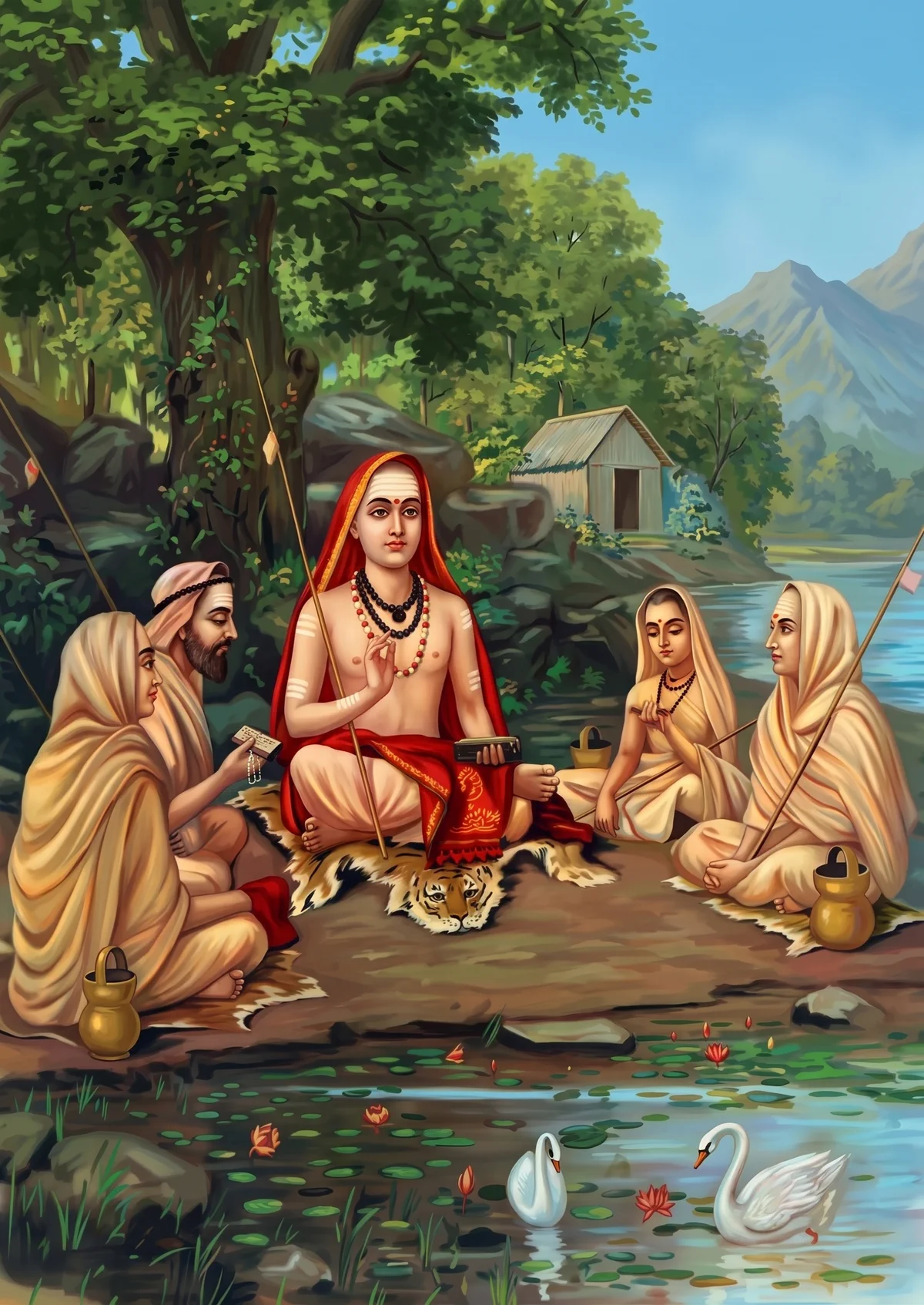
Scope of this introduction
This is an introductory map of Shankaracharya's Advaita Vedanta. It does not attempt to absorb Kabir into Shankara's system. A meaningful conversation is possible between the traditions, but their language, methods of establishing knowledge, and historical contexts remain distinct.
1. Advaita's central question
We ordinarily take ourselves to be limited individuals: this body is “me,” arising thoughts are “mine,” and the world is a separate object outside me. Three poles appear within this experience:
KnowerThe “I” that knows
KnowingThe act or means of knowledge
KnownThat which is known
Advaita does not erase everyday life by denying this practical structure. It asks: is that which illumines the entire knower–knowing–known experience itself merely one member of the triad?
If every thought is known, the knower cannot be just one more thought. If the body's changing conditions are known, that which knows cannot be confined to any one bodily condition. Inquiry into Atman begins here.
2. Adhyasa: the fundamental error
In the introduction to his commentary on the Brahma Sutras, Shankaracharya describes adhyasa as the mutual superimposition of the attributes of the Self and the non-Self. Put simply:
I place the characteristics of what I am not upon myself, while lending the light of my actual nature to the body and mind.
The body is tall or short, and we say, “I am tall.” The mind is sad, and we say, “I am sad.” The intellect does not know something, and we say, “I am ignorant.” Bodily and mental experiences are not being denied. The error is taking their changing conditions to be the final nature of the Self.
A familiar analogy makes this clearer:
Dim light+Rope+Prior conditioning→Experience of a snake
The fear of the snake is real as an experience, but its basis is a rope. Once the rope is known, no new substance is needed to remove the snake; correct knowledge cancels the error. In the same way, Self-knowledge does not produce Atman. It removes adhyasa.
3. Atman: not an object, but the witness
In Advaita, Atman is not another name for personality, memory, or a private story. All of these are objects of experience: they can be known, and their beginnings and changes can be observed. Atman is the self-revealing basis by which knowing is possible.
| What is observed | What changes | The question |
|---|---|---|
| Body | Childhood, youth, old age | What knows the change? |
| Sensory experience | Pleasant, painful, neutral | In what does the presence of experience appear? |
| Thoughts | They arise and subside | How is even the absence of thought known? |
| The I-notion | “I act,” “I know” | What recognizes this thought of “I”? |
Any attempt to grasp the witness as a visible object must fail, because every object that is grasped appears before the witness. The Upanishadic method of negation therefore says: neti, neti, “not this, not this.” This is not nihilism. It is a way of refusing to apply finite attributes to Atman as its final definition.
4. Brahman: the limitless ground
The Taittiriya Upanishad declares:
सत्यं ज्ञानमनन्तं ब्रह्म।
Brahman is reality, consciousness, and limitlessness.
Here, satyam, jnanam, and anantam are not three finite properties attached to Brahman from outside. They indicate that Brahman:
- does not depend upon another reality for its existence;
- is not an inert object, but consciousness itself;
- is not bounded by place, time, or object.
Brahman is not the largest object placed somewhere within the universe. Even “largest” belongs to the language of comparison and limitation. Brahman is the ground without which the existence of any object, experience, or knowledge cannot be established.
5. The mahavakya: Tat Tvam Asi
The Chandogya Upanishad's mahavakya tat tvam asi, “That you are,” opens Advaita's central recognition. It does not mean that a limited personality, complete with habits and personal history, is the omnipotent creator of the universe.
Tat
=Brahman free of limiting adjuncts
Tvam
Atman free of identification with body and mind
From tat, inquiry sets aside the particular adjuncts attributed to Brahman as the cause of the universe. From tvam, it sets aside body, mind, ignorance, and agency attributed to the individual. The consciousness indicated by both is one.
This is why aham brahmasmi, “I am Brahman,” is not a glorification of ego but the dissolution of its supposed boundary. The limited “I” does not become Brahman. Its underlying reality is recognized as never having been separate from Brahman.
6. Maya and the world: what does “unreal” mean?
Advaita is often reduced too quickly to “the world is false.” The more careful term is mithya: that which appears in experience and functions in practical life, yet depends upon a ground for its existence and has no independent reality of its own.
A clay pot has a distinct name and form. It can carry water, so it is not a meaningless hallucination. Yet the pot's existence is not independent of clay. When the pot breaks, clay remains; without clay, the pot never existed.
VyavaharikaThe empirical level at which individual, world, ethics, cause, and effect operate
ParamarthikaThe ultimate standpoint from which no second reality independent of Brahman can be established
The ultimate standpoint does not make practical life unethical or irrelevant. On the contrary, when the other is not utterly alien, compassion and non-harm gain a deeper foundation.
7. The discipline of knowledge
Self-knowledge is not merely assent to an attractive sentence. The Advaita tradition emphasizes preparedness, clarity of mind, and three disciplined movements:
ShravanaListening to the Upanishadic teaching and its intended meaning from a qualified teacher
MananaExamining doubts and apparent contradictions through reasoning
NididhyasanaAllowing understanding to become steady throughout life and experience
These are preceded by qualifications such as discernment, dispassion, mastery of mind and senses, endurance, concentration, and an intense desire for liberation. Action and worship do not replace Self-knowledge, but they can prepare the mind to receive it.
From this standpoint, liberation is not a state manufactured in the future. Whatever is produced will also end. Liberation is recognition of one's ever-present nature: praptasya praptih, the attainment of what is already attained.
8. A dialogue with Kabir
To treat Kabir and Shankaracharya as one voice would be unfair to both. A fruitful conversation between them is nevertheless possible.
Where their voices meet
- Name and form do not exhaust ultimate reality.
- Identification with the limited ego lies at the heart of bondage.
- Liberation concerns a transformation of identity, not external ritual alone.
- The ultimate cannot be grasped as a visible object.
Where differences remain
- Shankara treats the Vedas and Upanishads as decisive means of knowledge and develops systematic commentary.
- Kabir challenges scriptural authority and religious identity through sharp vernacular poetry.
- Advaita's technical vocabulary and the nirgun of sant poetry are not one historical project.
- Kabir addresses social and devotional tensions in a markedly different register.
Kabir's “Ram Niranjan” and Shankara's nirguna Brahman both reveal the limits of attribute, form, and concept. Their dialogue is fruitful only when affinities are recognized without erasing differences.
Study map
text
Ordinary experience
    │
    ├── “I am the body”
    ├── “I am the mind”
    └── knower and world are separate
             │
             ▼
           Adhyasa
             │
     Shravana → Manana
              ↓
         Nididhyasana
             │
             ▼
       Atman is the witness
             │
        Tat Tvam Asi
             │
             ▼
       Atman = Brahman
       Not two independent realities
IN ONE SENTENCEShankaracharya's Advaita teaches that liberation is not the event of making a finite person infinite, but the end of the superimposition by which limitless consciousness takes itself to be a limited person.