SURDAS · KRISHNA BHAKTI · READING 01
Madhukar Shyam Hamare Chor
Krishna steals the mind, breaks its bonds, and vanishes. A close reading of how beauty becomes surrender and absence becomes unbroken remembrance.
This pada is not merely a romantic description of Krishna. Its language of theft, beauty, bondage, sleeplessness, and helplessness describes a deeper devotional event: the ordinary claim to possess and govern one's own mind begins to give way.
The speaker complains of being robbed, but the complaint contains no real demand for restitution. Krishna's crime is also his grace.
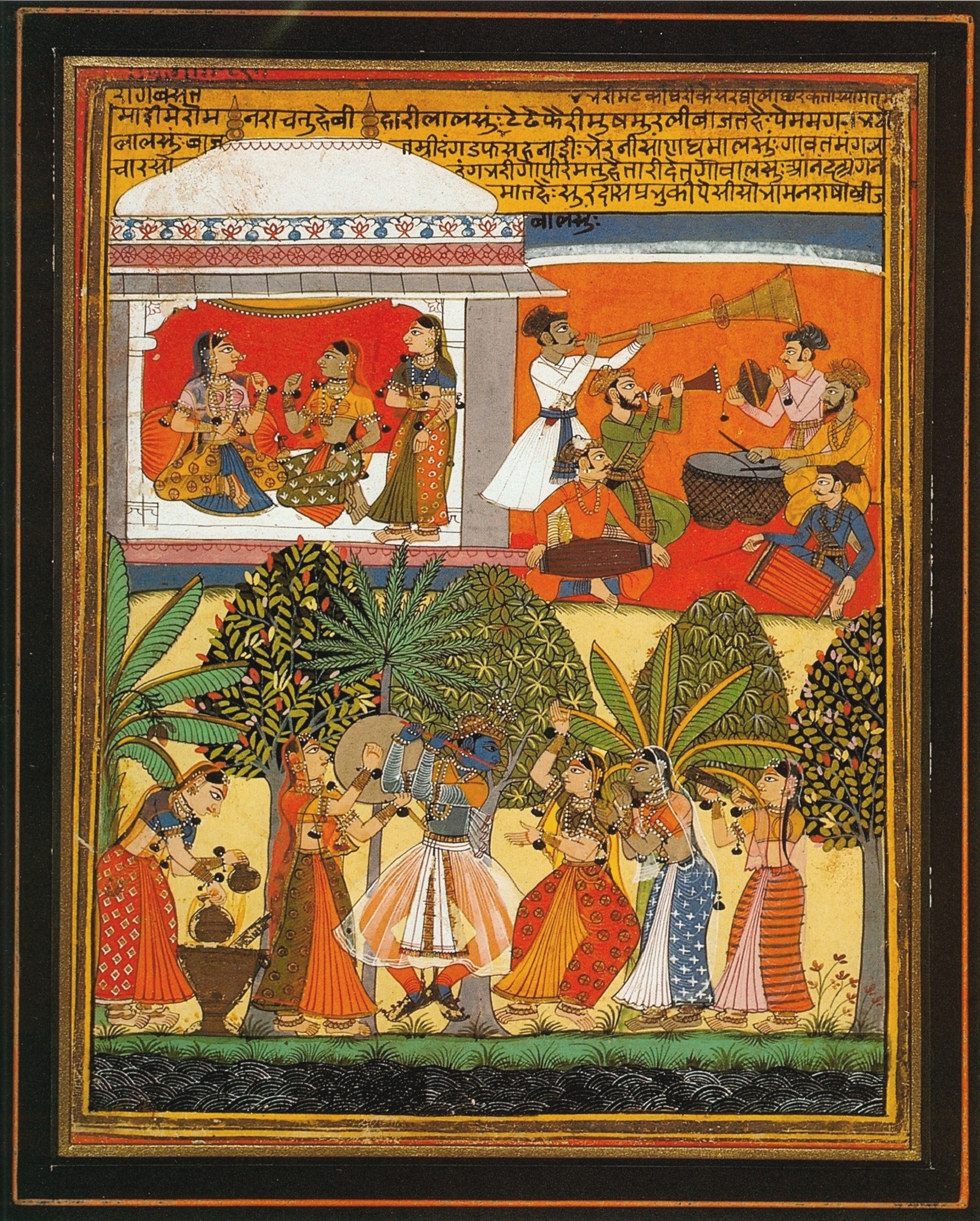
The complaintKrishna has stolen the one thing I called most intimately mine: my mind.
The discoveryThe theft loosens the very structure of “mine” that kept the self bound.
The pada
मधुकर श्याम हमारे चोर।
मन हरि लियो माधुरी मूरत,
निरख नयन की कोर॥
पकरेहु ते आनि उर अंतर,
प्रेम प्रीति के जोर।
गए छुड़ाय तोर सब बंधन,
दई गए हँसनि अकोर॥
उचक परो जागत निसि बीती,
तारे गिनत भई भोर।
सूरदास प्रभु हतो मन मेरो,
बरबस ले गयो नंद किशोर॥Bee-dark Shyam is our thief. His sweet form carried away the mind when glimpsed from the corner of the eye. Caught and brought into the heart by the force of love, he departed after loosening every bond, leaving the trace of a smile. Startled awake, the night passed; counting the stars, dawn arrived. Surdas says: this mind was mine, but Nanda's young son carried it away irresistibly.
Key words
- मधुकर
- Honeybee; a resonant figure in Krishna and bhramara poetry
- श्याम
- The dark one; Krishna
- चोर
- Thief
- हरि लियो
- Carried off, took away, stole
- माधुरी मूरत
- The form or embodiment of sweetness
- नयन की कोर
- The edge or corner of the eye
- उर अंतर
- Within the heart
- बंधन
- Bonds, ties, attachments
- निसि
- Night
- बरबस
- Irresistibly, forcibly, beyond one's control
- नंद किशोर
- Nanda's young son, Krishna
The translation is intentionally interpretive. In particular, the middle stanza admits more than one grammatical reconstruction. Its stable poetic movement is clearer than any single modern paraphrase: Krishna is caught in the heart through love, bonds are broken, and departure leaves a smile or its impress behind.
1. The beloved as thief
मधुकर श्याम हमारे चोर।
मन हरि लियो माधुरी मूरत,
निरख नयन की कोर॥Bee-dark Shyam is our thief. His sweet form carried away the mind when glimpsed from the corner of the eye.
The first word of consequence is not “beautiful,” “Lord,” or “beloved.” It is चोर, thief. Krishna has stolen something that cannot ordinarily be taken by another person: the inward faculty by which the speaker thinks, chooses, remembers, and says “I.”
The accusation is affectionate, but not decorative. It gives the whole pada its structure. A thief crosses a boundary, takes possession, and leaves the former owner unable to restore the old order. Divine love is presented not as one preference among others, but as an event that rearranges the center of consciousness.
There is also a familiar Krishna-bhakti echo. The child who steals butter becomes the beloved who steals the heart. The domestic mischief of Krishna’s stories is interiorized: now the object of theft is मन.
The devotee protests that Krishna has taken the mind, yet never truly asks for it back.
That paradox distinguishes this “crime” from ordinary loss. The complaint is already praise. Calling Krishna a thief is a way of confessing how completely his presence has prevailed.
Hari, the one who takes away
The phrase मन हरि लियो means that the mind has been carried off. Beside it stands the divine name Hari, traditionally heard in devotional speech with the resonance of हरना, to take away or remove. The poem therefore allows a suggestive double hearing:
This need not be forced into a strict etymological claim. Its poetic force is enough: Krishna is known precisely through what he does to the devotee’s inward life.
2. The glance that changes the seer
The theft requires no argument and no command. It happens through निरख नयन की कोर, a glimpse from the edge of the eye.
This is more than admiration of physical beauty. In devotional darshan, seeing is not a neutral act in which an untouched observer inspects a sacred object. The encounter changes the one who sees. Krishna’s माधुरी मूरत, his embodied sweetness, enters perception and displaces the mind’s previous occupations.
To behold→to be dispossessed
The corner-of-the-eye image makes the power of the encounter more striking. Krishna does not need a grand revelation. A partial glimpse is enough. The divine form acts before the speaker can organize, explain, or defend against it.
3. From visible form to the inner heart
पकरेहु ते आनि उर अंतर,
प्रेम प्रीति के जोर।Caught and brought within the heart by the force of loving affection.
The precise subject and direction of पकरेहु ते आनि vary with how the line is transmitted and parsed. Is Krishna caught and brought into the heart? Is the devotee seized and drawn inward? The ambiguity is fruitful because both motions belong to bhakti: the devotee holds Krishna in the heart, and Krishna takes hold of the devotee.
What is unambiguous is the movement from outside to inside:
दर्शनKrishna appears as a form before the eyes.
उर अंतरThe seen form becomes an indwelling presence.
प्रेम का जोरLove, not possession or proof, effects the passage.
The “force” here is प्रेम प्रीति, the pressure of love. Surdas does not make philosophical reasoning, ritual achievement, or mastery the decisive instrument. Bhakti is not merely a belief about God. It is a relation powerful enough to relocate the devotee’s center of gravity.
4. Bondage and release
गए छुड़ाय तोर सब बंधन,
दई गए हँसनि अकोर॥He departed after loosening every bond, leaving the trace of a smile.
Here the poem reaches its governing paradox. Krishna steals the mind, yet also breaks bonds. The act that looks like captivity becomes release.
On the immediate poetic level, बंधन belongs to the scene of catching, holding, and escape. In a devotional reading it also opens onto the ties that organize the ordinary self: attachment, fear, status, possession, and the insistence that body, mind, relationships, and achievements are “mine.” The poem does not list these abstractions; they are implications carried by its image of release.
What Krishna takesThe mind as private possession, defended by the claim “this is mine.”
What Krishna loosensThe bonds produced by that possessiveness and imagined self-sufficiency.
Ordinarily, losing control is not freedom. The bhakti claim is more precise: the surrender of the possessive ego to the beloved can be liberating. Krishna binds attention to himself and thereby unbinds it from the many things it had treated as final.
The smile that remains
The wording of हँसनि अकोर is among the uncertain points in this transcription. The image nevertheless carries a clear emotional residue: Krishna leaves, but a smile, the impression of a smile, or a playful trace remains.
There is no abstract revelation. A small remembered expression is enough to occupy consciousness after the beloved has gone. That remainder prepares the poem’s turn from encounter to separation.
5. The night of viraha
उचक परो जागत निसि बीती,
तारे गिनत भई भोर॥Startled awake, the night passed; counting the stars, dawn arrived.
The second half of the pada changes the emotional weather. Beauty and play give way to विरह, separation from the beloved. The speaker remains awake through the night, counting stars until morning.
This is not presented as successful meditation or serene insight. Surdas uses an unmistakably human experience: the body cannot sleep because longing has taken over attention. Bhakti does not discard that vulnerability. It makes vulnerability a mode of relation to the divine.
Viraha creates another paradox:
Krishna is absent→remembrance becomes continuous
Physical absence does not end the encounter. It makes every hour refer back to Krishna. Every star counted is evidence that the stolen mind has nowhere else to settle. Separation can therefore intensify a kind of inward presence, not because pain is inherently sacred, but because longing refuses forgetfulness.
6. “My mind was mine”
सूरदास प्रभु हतो मन मेरो,
बरबस ले गयो नंद किशोर॥Surdas says: Lord, this mind was mine; Nanda's young son carried it away irresistibly.
The ending should not be softened too quickly into “my mind was already yours.” In this wording, हतो मन मेरो preserves the remembered claim: the mind was mine. बरबस preserves the speaker’s lack of control. The poem needs that resistance because surrender is staged as an event, not announced as a doctrine.
Yet the singer who names the theft also ratifies it. To remember Krishna as नंद किशोर, the young son of Nanda, is to keep the thief intimately present. The former owner’s complaint has become a song offered to the one who stole from her.
The movement is therefore subtler than “I willingly gave my mind away”:
Surrender arrives after dispossession. The devotee discovers belonging through the failure of control.
7. The intimacy of Krishna bhakti
Why Krishna? Because the Krishna of madhurya bhava, the devotional mood of sweetness and belovedness, permits an intimacy unavailable to the language of a remote cosmic ruler. Krishna can be child, friend, lover, companion, prankster, and thief.
The devotee can therefore love him, miss him, tease him, accuse him, and complain to him. None of these gestures cancels reverence. They express a theology in which the divine is close enough to enter ordinary emotional grammar.
The romantic surface is not an embarrassment to be removed before the “real” spiritual meaning appears. It is the poem’s chosen instrument. Human longing supplies the language through which divine longing becomes imaginable.
| Poetic image | Devotional depth |
|---|---|
| Shyam’s beautiful form | Divine reality encountered as sweetness |
| The corner of the eye | Darshan that transforms the one who sees |
| The stolen mind | The failure of egoic ownership and control |
| Broken bonds | Release from attachments organized around “mine” |
| Krishna’s departure | Viraha, separation from the beloved |
| Counting stars | Remembrance sustained through the night |
| Krishna the thief | God taking possession of the devotee |
8. Is this Advaita?
Not in any simple sense. The poem inhabits the relational world of Krishna bhakti. Its intensity depends on a cherished distinction:
भक्त↔भगवान
The devotee loves Krishna, Krishna captures the devotee, and separation between them produces viraha. Classical Advaita instead asks whether the apparent separation of individual self and Brahman is ultimately real.
Advaita's pressure
- The separate ego is a superimposition.
- Knowledge reveals the identity of Atman and Brahman.
- Subject and object cannot be the final division.
Surdas's pressure
- The ego cannot remain an independent owner before Krishna.
- Love transfers the center of life toward the beloved.
- Relation, longing, and surrender remain precious.
The traditions need not be collapsed to be placed in conversation. Both challenge the sentence “I am the independent controller,” but they do so through different spiritual grammars: Advaita through discriminating knowledge, this pada through irresistible love.
The poem’s full movement
The twelve lines trace a complete devotional arc:
01 · दर्शनA glimpse of Krishna
02 · माधुर्यBeauty felt as sweetness
03 · मन-हरणThe mind carried away
04 · प्रेमLove draws him inward
05 · बंधन-मोचनThe bonds of “mine” loosen
06 · विरहThe beloved departs
07 · स्मरणAbsence becomes remembrance
08 · समर्पणThe theft ripens into surrender
The poem begins with an accusation: you are a thief. It ends with the speaker unable to reclaim what was taken. Between those moments, theft changes meaning. What first appears as violation becomes release from the possessive self.
The central paradox
Krishna does two apparently opposite things at once:
He steals the mind.
The devotee loses ordinary ownership and control.He breaks the bonds.
What seemed like loss opens into devotional freedom.
Viraha completes the paradox. Krishna is gone, yet the mind remains wholly occupied by him. His absence becomes a form of uninterrupted presence in remembrance.
IN ONE SENTENCEWhen divine love becomes complete, the ego's claim of ownership over the mind loosens: what appears as theft becomes surrender, and what appears as separation becomes constant remembrance.